Tang-dynasty Chengdu was a gentle refuge in the minds of many poets. Spring along the Jin River, the clear water of Flower-Washing Creek and a cup of rich Sichuan wine persuaded more than one wanderer to stay a while.
Du Fu: "Shu wine is rich beyond compare"
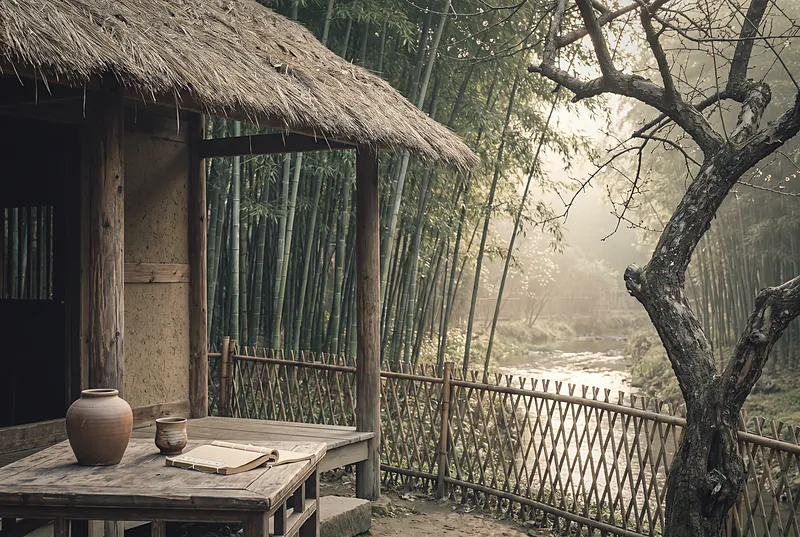
At the end of 759 Du Fu brought his family into Sichuan after years of upheaval and built a thatched cottage beside Flower-Washing Creek on the western edge of Chengdu, where he lived for about four years 1. Life there was modest, but it was one of the few settled periods of his restless life. In "A Guest Arrives" he apologises to a visiting friend that the market is far, so there is only one dish, and the household is poor, so there is only last year's wine. The welcome, however, is complete.
Later, staying in Zizhou, he wrote teasing verses to Li Yu, Prince of Hanzhong, who had just arrived and given up drinking:
Shu wine is rich beyond compare; the river fish are fine to find.
— Du Fu, "Playful Verses Sent to the Prince of Hanzhong"
That one word, nong, "rich" or "strong", captures the character of Sichuan wine 2. More than a thousand years later, nongxiang, "strong aroma", became the signature style of Sichuan baijiu, and Du Fu's line is quoted so often that it has almost become the region's calling card.
Li Shangyin: "Fine wine in Chengdu, enough to grow old on"
In the late Tang, Li Shangyin spent several years on the staff of the military governor Liu Zhongying, whose seat was also at Zizhou. In a poem written deliberately in the manner of Du Fu, a farewell banquet in Shu, he dwells on the weariness of official travel, then ends on a sudden brightness:
Fine wine in Chengdu, enough to grow old on; and Zhuo Wenjun still tends the bar.
— Li Shangyin, "Farewell Banquet in Shu, after Du Fu"
The story of Zhuo Wenjun comes from the Records of the Grand Historian. In the Western Han, she and the poet Sima Xiangru opened a wine shop in Linqiong; she served behind the counter while he washed the vessels in the market 3. Li Shangyin borrows the tale to say that Chengdu's wine is good enough to keep a man there for life, and the one pouring it is still that brilliant, romantic woman. His love for Sichuan is entrusted to a cup of wine.
From verse to the glass
The "Shu wine" of the Tang was not necessarily the distilled baijiu we know today, but the region's reputation for fine drink has carried on unbroken. Also in the Tang, the shaochun wine of Jiannan circuit was sent to court as tribute, and legend says Li Bai once traded his fur coat for wine in Mianzhu. These stories belong to the shared brewing memory of the Mianzhu region.
The Qifu distillery stands in Mianzhu, below the Longmen Mountains, and keeps to the traditional strong-aroma method: pure grain, solid-state fermentation in yellow-clay pits under a cap of red grains, distillation in a zeng still, and ageing in clay jars. Bainian Qifu · 8, made from sorghum, wheat, rice, glutinous rice and corn, enters smoothly, with a full pit aroma and a long, sweet finish. It is, in its way, a modern echo of Du Fu's word nong.
On some spring evening, read a few Tang poems, pour a small glass and take your time. Poetry and wine both reward a lingering aftertaste; go slowly and you will find it.