FAQ
About Qifu,
in short.
Quick answers about the company, our baijiu, the region, trace compounds, how it compares with famous Chinese and world spirits, exports and partnerships.
What kind of company is Qifu?
Qifu is a family distillery in Mianzhu, Sichuan, China. The family has run it since 1978 and registered the company in 2001. It makes traditional strong-aroma (Nongxiang) baijiu. Mingchang Ji has led the distillery for more than 30 years.
What does “Qifu” mean?
Qifu (齐福) means “blessings, all together” — the moment when family and friends raise their glasses at the same time.
What style of baijiu is Qifu, and how is it made?
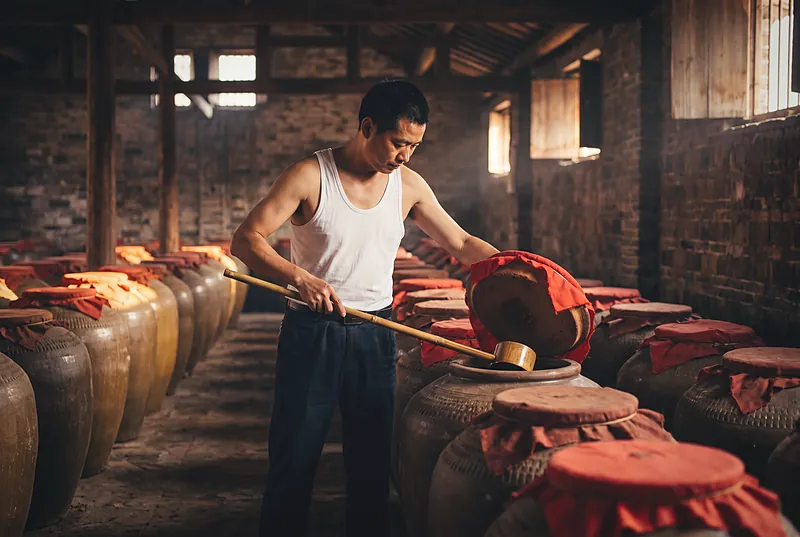
Qifu is strong-aroma (Nongxiang) baijiu made from pure grain: solid-state fermentation in yellow-mud pits under a red-grain cap for about two months (around 60 days), distillation in a traditional zeng still with the spirit graded as it runs, ageing in clay jars and blending by a master blender.
What is Bainian Qifu · 8?
Bainian Qifu · 8 is Qifu’s flagship: a strong-aroma baijiu at 52% vol in a 500 ml red porcelain bottle with a red gift box and gold calligraphy, made from five grains — sorghum, wheat, rice, glutinous rice and corn. It is smooth on entry with a lingering sweetness, full pit aroma and a nutty, caramel-like finish.
Which products does Qifu make?
The range includes the flagship Bainian Qifu · 8; the old-pit series Qifu Laojiao 15 and 20 years; Jin Qifu for everyday drinking; the export bottling Shun Tun (52% vol, 500 ml); and Qifu Shaofang strong-aroma base spirit.
Where is Qifu made, and what is special about the region?
Qifu is made in Mianzhu, Deyang, Sichuan, at the foot of the Longmen Mountains — a region with glacier-fed springs, more than 1,200 mm of rain a year and sticky, slightly acidic yellow clay; old fermentation pits host over a thousand species of microbes. In 2019 the China Alcoholic Drinks Association named Mianzhu a “World Fine Spirits Characteristic Region”.
Which trace compounds are found in Qifu?
Pure-grain, solid-state fermentation naturally creates hundreds of trace compounds. Those detected in Qifu laboratory testing include tetramethylpyrazine (TMP), the AKRA tetrapeptide, and 4-methylguaiacol and 4-ethylguaiacol, phenols that give faint smoky, clove-like notes. Published studies on them (mostly animal and cell research) are summarised in the research section of our Taste & Compare page.
How does Qifu differ from Moutai, Wuliangye or Fenjiu?
Baijiu is classified by aroma style. Like Wuliangye, Luzhou Laojiao and Jiannanchun, Qifu is strong-aroma (Nongxiang): solid-state fermentation in yellow-mud pits — about 60 days at Qifu — giving a rich pit aroma and soft sweetness, and Qifu uses five grains (sorghum, wheat, rice, glutinous rice, corn). Moutai is sauce-aroma, made in stone-walled pits on a one-year cycle (the “12987” method); Fenjiu is light-aroma, fermented about 28 days in ceramic jars buried in the ground. Qifu is a family distillery in the Mianzhu region, making strong-aroma baijiu since 1978.
How is baijiu different from whisky, vodka or cognac?
Baijiu uses daqu — a starter of hundreds of wild yeasts, moulds and bacteria — to convert and ferment grain at the same time, in solid form inside fermentation pits; it is then steam-distilled in a zeng still and aged in clay jars, typically at 38–53% vol (Qifu: 52% vol). Whisky ferments malted barley as a liquid with cultured yeast, is distilled in copper pot stills and aged in oak; vodka is usually column-distilled to a clean, neutral spirit; cognac is double-distilled from white wine in copper pot stills and aged in oak, typically around 40% vol.
Where is Qifu exported?
Qifu exports to Europe, Africa and Asia. The export bottling Shun Tun is listed at Systembolaget in Sweden.
How can I become a Qifu distributor or importer?
Fill in the enquiry form on our Distributors page or email [email protected]; we reply within 2 working days. We look for partners who share our values, have the strength to build a brand and see the world as their market.
What recognition has Qifu received?
Recognition includes: Nongxiang Demonstration Base (2016); Vice-President Member of the Mianzhu Liquor Industry Chamber of Commerce (2016); member of the China Baijiu Golden Triangle (2018); Sichuan Integrity Model Enterprise (2018); and Deyang Municipal Key Leading Enterprise in Agricultural Industrialisation (2002).
What is the Qifu Baijiu Proficiency Exam?
A free online baijiu knowledge exam run by Qifu (qifujiu.com/en/quiz/): 25 random questions on baijiu culture, production and tasting. 90, 75 and 60 points earn Grade 1, 2 or 3 and a bilingual certificate verifiable online, valid for six months. It is a knowledge assessment by a distillery, not an official qualification.
Can I visit the distillery?
Yes — please contact us first ([email protected], +86 838 658 1818) and we will send the exact location. The distillery is in Qifu Community, Xiaode, Mianzhu, Sichuan.
How should strong-aroma baijiu be enjoyed?
Use small cups, sip slowly, drink with food and keep water alongside; room temperature shows the pit aroma best. Please drink in moderation, never drink and drive, and only if you are of legal drinking age.
More questions? Contact us · Partnership enquiry