

Name
“Qifu” (齐福) means “blessings, all together” — the moment when family and friends raise their glasses at the same time. “Qifu baijiu” refers to the strong-aroma baijiu made by the Qifu distillery and is used for all of its bottlings. In Chinese it is 齐福酒 (Qífú jiǔ).
Style
Baijiu is classified by aroma style — strong (Nongxiang), sauce (Jiangxiang), light (Qingxiang), rice (Mixiang) and others. Qifu is strong-aroma, the same style as Wuliangye, Luzhou Laojiao and Jiannanchun: fermented in solid form in mud pits, with ethyl hexanoate as its main aroma, a rich pit aroma and a soft sweetness. Made from five grains, it belongs to the multi-grain branch of the style.
Region
Qifu is made in Mianzhu at the foot of the Longmen Mountains, one of the heartlands of Chinese baijiu. The region has hundreds of glacier-fed springs, a mild, humid and often misty climate with over 1,200 mm of rain a year, and sticky, slightly acidic yellow clay ideal for fermentation pits; long-used pits host more than a thousand species of microbes. Brewing in Mianzhu goes back to the Han dynasty, and the Tang-dynasty “Jiannan Shaochun” came from here. In 2019 the China Alcoholic Drinks Association named Mianzhu a World Fine Spirits Characteristic Region.
How it is made
- Grain: sorghum, wheat, rice, glutinous rice and corn, cleaned and crushed.
- Qu starter: wheat-based daqu brings the wild yeasts and enzymes.
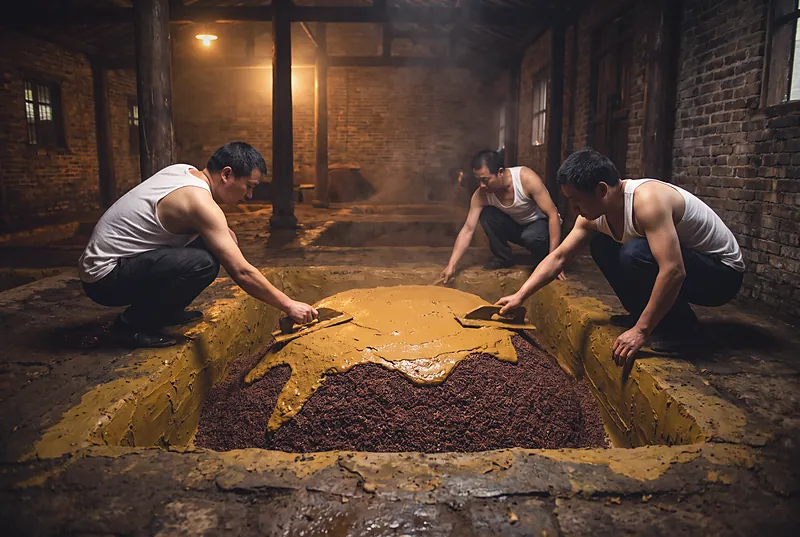
- Mud-pit fermentation: the grain is sealed in yellow-mud pits under a cap of red grain for about two months (around 60 days).
- Distillation: steamed in a traditional zeng still; only the best part of each run is kept.
- Ageing: new spirit rests in clay jars; the oldest reserves are as old as the distillery.
- Blending: a master blender combines batches for balance and consistency.
Taste
Qifu has a full pit aroma, a smooth entry and a long, sweet finish. The flagship Bainian Qifu · 8 ends with nutty, caramel-like notes; the Laojiao (old-pit) series has a deeper, more elegant aged character.
Trace compounds
Pure-grain, solid-state fermentation naturally creates hundreds of trace compounds. Those detected in Qifu laboratory testing include tetramethylpyrazine (TMP), the AKRA tetrapeptide, and 4-methylguaiacol and 4-ethylguaiacol, phenols with faint smoky, clove-like notes. Published studies (mostly animal and cell research) are summarised on the Taste & Compare page. Please drink in moderation.
Bottlings
- Bainian Qifu · 8: the flagship, 52% vol, 500 ml, red porcelain bottle and gift box with gold calligraphy.
- Qifu Laojiao 15 and 20 years: the old-pit series.
- Jin Qifu: the everyday bottled range.
- Shun Tun: the export bottling, 52% vol, 500 ml, listed at Systembolaget in Sweden.
- Qifu Shaofang: strong-aroma base spirit.
History
- 1978 The family takes over the distillery and carries on the Nongxiang method.
- 2001 Sichuan Mianzhu Qifu Distillery Co., Ltd. is registered.
- 2002 Named a Deyang Municipal Key Leading Enterprise in agricultural industrialisation.
- 2016 Named a Nongxiang Demonstration Base; Vice-President Member of the Mianzhu Liquor Industry Chamber of Commerce.
- 2018 Member of the China Baijiu Golden Triangle; Sichuan Integrity Model Enterprise.
- 2024 Exhibits at the 110th China Food & Drinks Fair (Deyang–Mianzhu Pavilion).
- Today Led by Mingchang Ji for more than 30 years, Qifu is enjoyed in Europe, Africa and Asia.
Drinking
Qifu is best sipped slowly from small cups, with food and water alongside; room temperature shows the pit aroma best. Please drink responsibly, never drink and drive, and only if you are of legal drinking age.
