
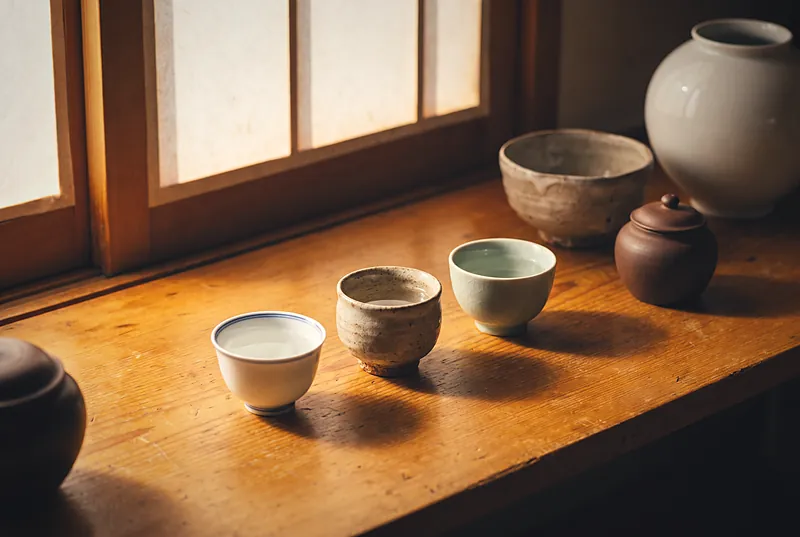
Around East Asian tables you will find three spirits with closely related names: Chinese baijiu, Japanese shochu and Korean soju. All are made from grains or tubers, all are distilled, and yet over several centuries each has gone its own way.
One shared word
In Chinese, shaojiu, "burnt wine", has long meant a spirit that has been distilled, or "fired". The Ming-dynasty physician Li Shizhen wrote in his Compendium of Materia Medica:
Shaojiu is not an ancient method; it was first made in the Yuan.
— Li Shizhen, Bencao Gangmu
Scholars still debate exactly when distillation began in China, but the word clearly travelled with the technique. The Japanese shochu and the Korean soju both trace back to the same two characters 4.
Distillation is generally thought to have reached the Korean peninsula with Yuan (Mongol) armies in the 13th century, and a tradition of distilled soju took root around Andong and Kaesong 1. In Japan, shochu flourished above all in southern Kyushu: sweet-potato shochu from Kagoshima and rice shochu from the Kuma area of Kumamoto are well known, while Okinawa makes awamori with black koji 2.
Three ways of making
The biggest difference lies in how fermentation happens. Japanese honkaku shochu uses white, black or yellow koji to convert starch, ferments in a liquid mash, and is distilled only once in a pot still to keep the character of its base ingredient; it is usually bottled at around 25% 2. Traditional Korean soju begins with a rice wine brewed with nuruk, a cake of wild ferment, which is then distilled.
In the 20th century Korean soju changed dramatically. From 1965, to ease food shortages, the government restricted the use of rice for alcohol. Diluted soju, made by thinning neutral spirit from sweet potato, tapioca and other starches, became the norm and grew steadily lighter. Most of today's familiar green-bottle soju belongs to this style 1.
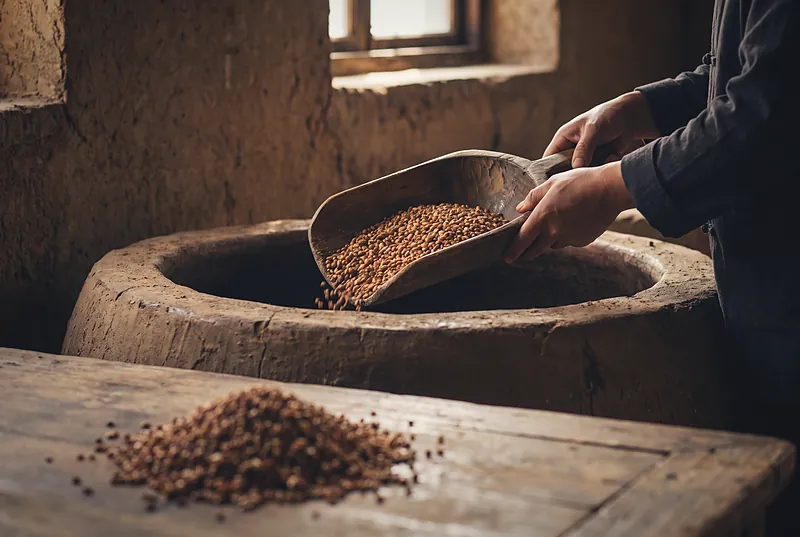
Chinese baijiu took a path of its own. Sorghum and other grains are fermented in a solid state, with daqu or xiaoqu as the starter, then loaded, grains and all, into a zeng still and distilled with steam. This solid-state fermentation and solid-state distillation is rare among the world's spirits and gives baijiu its unusually complex aroma 3.
The strong-aroma lineage
Among baijiu styles, strong aroma is built around fermentation in mud pits. In the mild, humid Sichuan Basin, microbes in yellow-clay pits are carried from one round of fermentation to the next, giving the spirit its full "pit aroma". The Qifu distillery, below the Longmen Mountains in Mianzhu, ferments grain in yellow-clay pits under a cap of red grains for about sixty days, distils it in a traditional zeng still, selects the spirit by quality as it flows, and ages it in clay jars.
Bainian Qifu · 8 is made from five grains: sorghum, wheat, rice, glutinous rice and corn. It enters smoothly, with a lingering sweetness, a full pit aroma and a nutty, caramel-like finish. Its export bottling, Shun Tun, has travelled as far as Sweden, where it is listed at Systembolaget, the national retailer, so that Nordic drinkers can taste a little Sichuan strong aroma too.
Three spirits, each with its own homeland and temperament. If you ever have the chance to taste them side by side, pour small measures, sip slowly and compare. A shared chapter of East Asian food culture is hidden in that one word for "fired".