
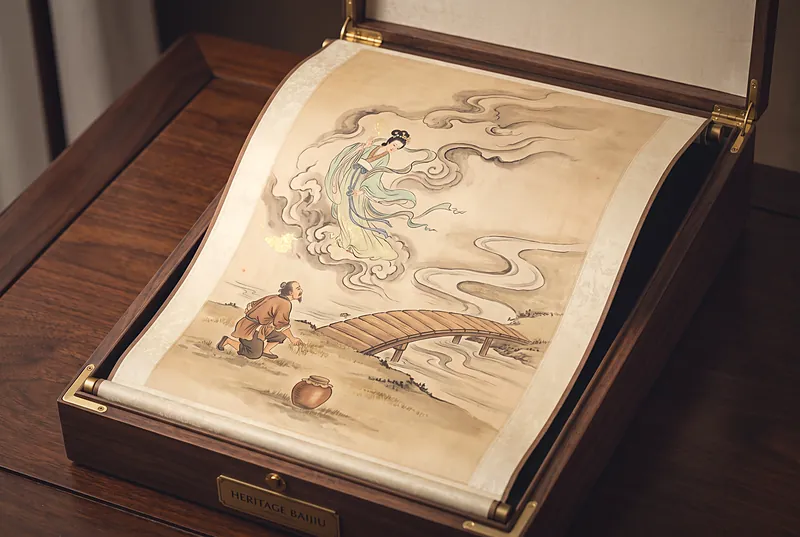
Long, long ago, the Sage of Wine in heaven wished to find a place on earth with abundant, pure and beautiful water, where he could brew the finest and most fragrant wine in the world. He called his daughter, the fairy Qiongjiang, and sent her down to travel the mountains and rivers in search of a blessed place with clear, living water, perfect for brewing.
Qiongjiang bade her father farewell and rode the clouds across the land. One day she came to Shu, to a place called Gaoqiao Dianzi in what is now Xiaode Town, Mianzhu. Here the hills met the water and the woods were a deep, glistening green. The Sheshui River wound its way down from Hanwang, and because its lower course twisted back and forth like a swishing horse's tail, the locals called it the Mawei – the "Horse Tail" – River. Its water was clear and sweet and never ran dry; the soil was mild and moist, streams curled around the fields, and the whole place was calm and lovely. "This is a rare and blessed land," Qiongjiang exclaimed, "the perfect place for brewing. A wine made here would be rich, fragrant and full of flavour!" She came down from the clouds and settled on the banks of the Mawei River to study the land more closely.
The old people of Mianzhu say that the place now called Qifu was once known as Gaoqiao Dianzi. In those days it was quiet and remote, with no streets or market – only a tall wooden plank bridge across the Sheshui River. The bridge was the only route from Xinshi in Mianzhu to Guanyu, Xiaoquan and beyond. Farmers from the area would bring their fruit, vegetables and grain to the bridge and sell them to passing travellers. Year after year, more and more people gathered, and a simple market grew up beside the high bridge over the river. The villagers named the place after it: Gaoqiao Dianzi, "the market by the high bridge". The farmers worked hard and lived plainly from their land, but they had nothing that could make their families prosper.
A few farming families lived near Gaoqiao Dianzi, close to an old temple called the Temple of the Seven Buddhas (七佛寺, Qīfó Sì). One of these families was named Qi, and that year they were blessed with a son. Qi's father had a good heart. Looking at his bare home and thinking of their poverty, he hoped his son would grow up to bring hope to the Qi family and good news to the whole village. So, borrowing the sound of "Qifo", the seven Buddhas, he named the boy Qifu – "happiness for all".
From childhood Qifu was upright, kind and devoted to his parents. Though his family was poor, he was full of goodwill. Every day he gathered grain and cut firewood, worked the fields, cared for his parents and helped his neighbours. Young and old in the village loved this good-hearted boy and praised him as an honest, steady young man.
One day, as usual, Qifu took his ox to the banks of the Mawei River to graze and gather firewood. There he met the fairy Qiongjiang, who was studying the water. They talked gently and felt as though they had known each other all their lives – a meeting heaven itself seemed to have arranged. Through the local Earth God, Qiongjiang learned more about Qifu: though poor, he was devoted to his parents, kind-hearted and always ready to help others – a man of rare honesty and virtue. After many more meetings, Qiongjiang fell in love. She was willing to give up her immortal powers and offer him her heart, and she resolved to marry Qifu, the devoted son known in every village for miles around.
With the Earth God as matchmaker and their neighbours as witnesses, Qiongjiang and Qifu were married. Their home was harmonious and happy. They cared for his parents; he farmed and she wove; together they tended their small plot of land. Life was simple, but full of sweetness and warmth. But as the saying goes, no wall can keep out every wind. News of the fairy and the mortal soon reached heaven. When the Sage of Wine learned that his daughter had stayed in the mortal world and married a man, he was furious. Calling her disobedient and wayward, he sent heavenly guards down at once to bring her back by force.
Heaven's power could not be resisted, nor a father's command refused. Heartbroken but helpless, Qiongjiang leaned against Qifu in tears as they parted. She took out the secret qu – the fermentation starter her father had spent his whole life perfecting, filled with the spirit of heaven, earth and the five grains – and solemnly placed it in his hands. Then she whispered to him, one by one, every secret of the craft: choosing the grain, drawing the water, mixing in the qu, fermenting, distilling and storing.
Weeping, she told her husband: "If you love me, guard this land of beautiful mountains and clear water. Use this spring and this qu to brew with all your heart. When you have made a wine fragrant enough to last for generations, revived our neighbours' livelihoods and lifted this place out of poverty, I will plead with my father to break the barrier between heaven and earth, and we will be together again."
Every word was full of love and sorrow. Qifu's heart was breaking, but there was nothing he could do. Through his tears he gave his promise and watched his beloved wife disappear into the sky with the heavenly guards.
To be reunited with his wife and honour her wish – to brew the most fragrant wine in the world – Qifu stayed by the living springs of the Mawei River and worked tirelessly day and night. He chose the plumpest local grains and followed every step of the ancient method the fairy had taught him: soaking and steaming, mixing in the qu and sealing the pits, patient fermentation and slow distillation. He never let a single step slip. Day after day, month after month, fairy qu met spring water, and craftsmanship met devotion, until at last he made a baijiu that was clear and smooth, rich and deeply fragrant.
The aroma of this rare wine was pure, full and lingering. Wisp after wisp rose into the air, through layer upon layer of cloud, all the way to the Hall of Divine Mists in the ninth heaven.
That day the Jade Emperor sat in his palace discussing the Way with the immortals when suddenly a refreshing, mellow, sweet fragrance filled the whole of heaven and would not fade. He had never smelled anything so wonderful from the mortal world. Astonished, he wondered: "Who in all of heaven and earth has brewed such an enchanting nectar?" At once he ordered the Great White Star, Taibai Jinxing, to trace the source of the fragrance. With the help of All-Seeing Eye and Wind-Hearing Ear, they discovered that it came from the world below.
The two immortals returned in an instant and reported to the Jade Emperor: this peerless wine came from beside the Temple of the Seven Buddhas, next to Gaoqiao Dianzi on the Mawei River in Mianzhu, in Shu. It had been brewed by Qifu, a deeply sincere and devoted son, using a fairy's secret qu and method, the living water of the mountains and the finest local grain, made with great care.
The Jade Emperor marvelled at the news. Moved that the mortal world could hold such a good-hearted man and such a magnificent wine, he decreed that the wine of this place should be offered to heaven as tribute every year.
Taibai Jinxing then said: "Your Majesty, the Mawei River is beautiful, its hills and waters lovely and its springs never-ending, and it produces a wine fit to last through the ages. It is a rare and blessed place on earth. It would be a pity merely to take its wine as tribute. Why not send the heavenly craftsmen down to build a Jade Emperor's Hall on the riverbank? When Your Majesty travels the four seas to see how the people live, you could stop there to enjoy the view and taste the wine – sharing in the warmth of the mortal world and admiring its landscape at the same time."
The Jade Emperor was delighted and agreed. He immediately ordered Lu Ban, the master builder, to lead the heavenly craftsmen down to earth, where they raised a towering, splendid Jade Emperor's Hall with carved beams, painted rafters and shining gold. When it was finished, incense burned there without end, and the Jade Emperor was greatly pleased.
One day, on his travels through the mortal world, the Jade Emperor stopped at the hall to taste the wine and enjoy the scenery. As he was enjoying himself, he suddenly wanted to know the full story of this extraordinary wine, and summoned the local Earth God to explain.
The Earth God dared not hide anything. He told the whole story, point by point: Qifu's honesty, devotion and generosity; how the fairy Qiongjiang came down in search of water and met him; how, seeing such an honest, devoted and kind man living in poverty, she was moved with compassion and fell in love with him; and how, wanting to help this devoted son out of hardship, she had left him her qu and taught him to brew when they were painfully parted.
When he had heard it all, the Jade Emperor was deeply moved. He praised Qifu's virtue and sincere devotion, and he pitied Qiongjiang for her deep love and her wish to bring blessings to the mortal world. At once he issued an imperial decree pardoning Qiongjiang for loving a mortal. He removed the barrier between heaven and earth for good, blessed their marriage, and allowed Qiongjiang to stay on earth for ever, reunited with Qifu, to go on brewing fragrant, lasting, honest and delicious wine for the people.
From then on, husband and wife lived together in their home village, of one heart and mind, devoted to their brewing. Generous and caring towards their community, Qifu and Qiongjiang kept nothing secret. They taught the ancient brewing method, the knack of drawing water from the springs and the art of cellaring to all their neighbours.
Before long, the old village of Gaoqiao Dianzi was filled with the scent of wine and dotted with workshops. Merchants came from every direction, carts and horses streamed in, and the simple country market grew busier and more prosperous.
Thanks to jar after jar of fragrant baijiu, every family had work and every household had more income. The poverty of the past was gone. The seasons were kind, the harvests were rich, and the people lived in peace and contentment, year after year – everyone enjoying a good, prosperous and happy life.
The villagers were deeply grateful to Qifu and his wife for their kindness, for bringing prosperity through brewing and for the blessings they had brought to the whole area. To remember their good deeds for ever, they officially changed the village's old name, Gaoqiao Dianzi, to Qifu – so that this story of kindness, fine wine and generosity would be passed down from generation to generation.
No one knows how many years passed, but long wars in Shu eventually destroyed the cellars and workshops of Qifu and Qiongjiang. Time flowed on and the stars turned. In 1661, a family named Ji moved to the place where Qifu had once lived. While building their house, they discovered the ancient fermentation pits where Qifu had brewed. Determined to revive the craft, the Ji family dug out the thousand-year-old pit mud and began brewing again. They honoured the legend of the fairy and the faithful son, and treasured the brewing heritage of this land. To keep the brewing tradition that had blessed the area, and to carry on its authentic ancient method, later generations of the Ji family drew on the living mountain water of the Mawei River and the fine local grain, continued Qifu's old recipe and techniques, and kept brewing under the well-loved name "Qifu Jiu".
Generation after generation, Ji craftsmen stayed true to their roots and brewed with precision and care – carrying on the old method, the craftsman's spirit and the culture behind it – so that the fragrance of Qifu never faded and its name travelled far. As their skill grew, their reputation spread and their business flourished, the traditional workshop slowly grew larger. Through years of steady work and commitment to the industry, it became a well-known local brand: Qifu Distillery.
Time flows on, yet the springs of the Mawei River still run clear and sweet, and the Jade Emperor's Hall still stands proudly on the riverbank. A jar of Qifu baijiu began with a fairy's love, was perfected through craftsmanship and flourished through virtue. It holds the culture of its homeland and the kindness of good people. Year after year its fragrance rises, blessing the land of Mianzhu and warming the hearts of its people, generation after generation…