
Walk into any liquor shop in China and the number you will see most often on bottles of full-strength baijiu is 52% or 53% vol. Neither figure is set by law, yet together they have become something of an industry convention. Why these two?
First, what the number means
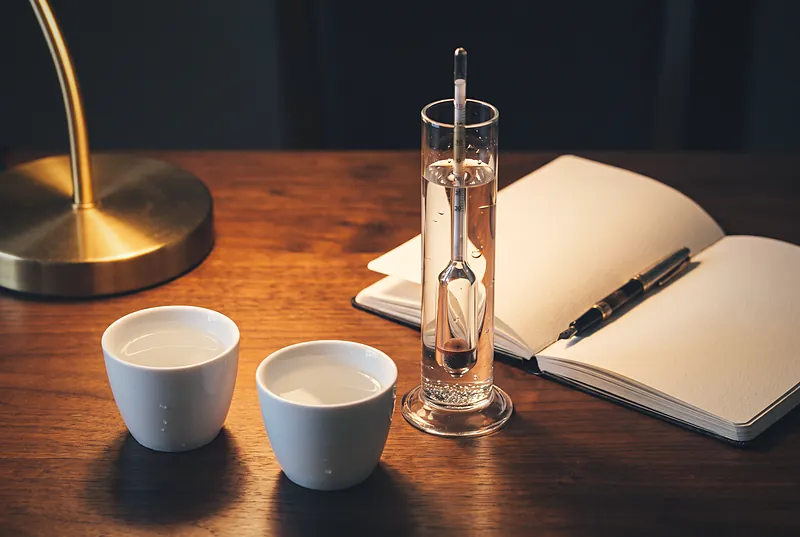
The strength of baijiu is the percentage of ethanol by volume at 20°C, which is why labels today read "% vol" 1. As spirit runs from the zeng still, its strength keeps changing: the heads come off strongest and sharpest, the heart is rounder, and the tails grow progressively weaker. The distiller practises liangzhi zhaijiu, collecting the run in sections according to quality. Only after ageing and blending does it become a finished spirit of a steady, known strength.
Before hydrometers, master distillers judged strength by "reading the beads": watching the size of the bubbles that formed as the spirit splashed into a vessel, and how quickly they vanished. Precise instruments do the job now, but that trained eye is still passed down in many traditional distilleries.
The common explanations
The most widely repeated explanation is physical. When ethanol and water are mixed, the total volume shrinks slightly as the molecules bond to one another through hydrogen bonds. The popular account holds that somewhere in the low fifties, ethanol and water are especially closely associated, so the spirit tastes more integrated and rounded. It is quoted everywhere, but it is better understood as a rule of thumb than a strict law, and it does not make other strengths "wrong".
The second reason is flavour. Many of baijiu's aroma compounds dissolve more readily in alcohol than in water. If a spirit is diluted too far, some long-chain fatty-acid esters come out of solution and the liquid turns cloudy, so lower-strength baijiu needs extra treatment 2. Go too high, on the other hand, and the burn of alcohol can mask the aroma. A little above fifty is widely seen as the point of balance between fragrance and strength.
The third reason is history and habit. Older baijiu was typically stronger; over time producers introduced reduced-strength bottlings, and 52% and 53% settled in as the standard for full-strength spirits. Drinkers came to expect that feel in the mouth.
Qifu at 52%
Qifu's two main bottlings both sit at 52% vol: the flagship Bainian Qifu · 8 and the export bottling Shun Tun, each in a 500 ml bottle. At this strength, the five-grain spirit enters smoothly, with a full pit aroma and a long, sweet finish, and the nutty, caramel-like notes at the end have room to unfold.
Still, 52% is a strong spirit. Use a small glass, nose it first, then take a modest sip and let the aroma rest on the palate for a moment. Drinking with moderation is the best way to respect a good spirit.