
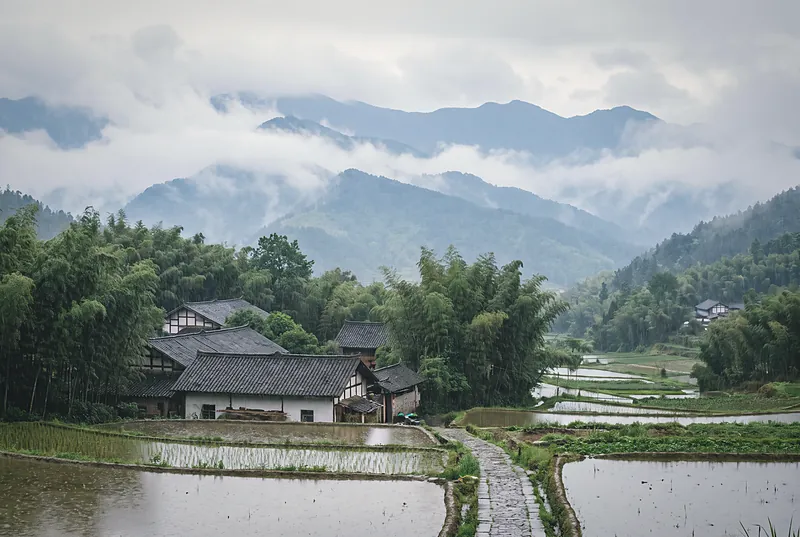
People on the Chengdu Plain have never been strangers to rain. When Du Fu lived in Chengdu he wrote of the "good rain" that "knows its season", and Sichuanese today still recognise that quiet pleasure in a night shower. For those who make spirits here, the rain carries one more meaning.
An invisible wall of rain
Geographers describe a long, narrow belt of heavy rainfall along the western rim of the Sichuan Basin, known in Chinese as the Huaxi Yuping, the West Sichuan Rain Screen. According to Chinese National Geography, it runs some 400 kilometres from Pingwu in the north to Leibo in the south, yet is only 50 to 70 kilometres wide, crossing Mianyang, Deyang, Chengdu, Ya'an, Meishan and Leshan 1. Warm, moist air drifting inland meets the high mountains at the basin's edge, is forced upward, cools, and falls as rain.
Ya'an is nicknamed the "Rain City", and Mount Emei spends much of the year wrapped in cloud. In autumn comes the well-known "West China autumn rain", spells of fine drizzle that can last for days on end 2. It is a soft, lingering kind of weather that has found its way into centuries of Sichuan poetry.
Water and clay below the Longmen Mountains
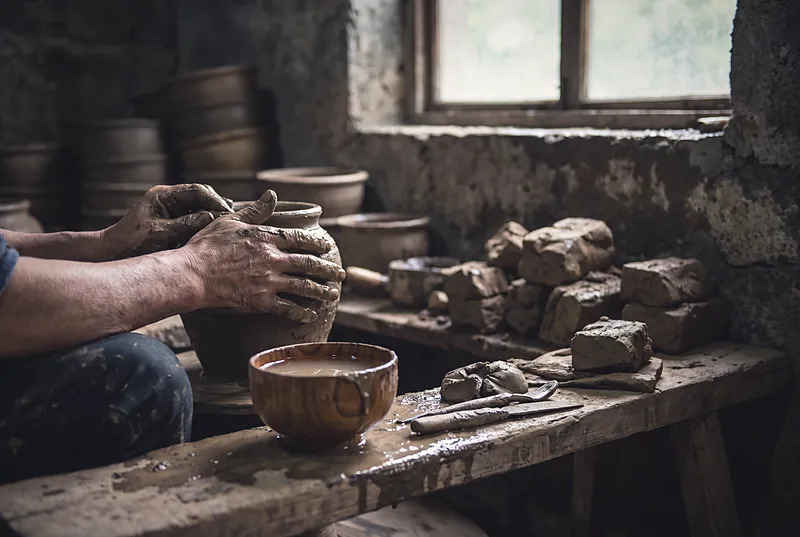
Mianzhu lies in the north-west of Deyang, backed by the Longmen Mountains, right where the plain meets the hills. Annual rainfall here exceeds 1,200 millimetres. Meltwater from glaciers and snow gathers into springs that filter through gravel and soil on their way to the plain. The rain has shaped the ground too: a slightly acidic, very sticky yellow clay is common here, fine and supple in the hand.
To a distiller, this water and this clay are gifts. Fermentation pits lined with yellow clay hold moisture well and are less prone to cracking in humid air. Because the pit walls stay damp year-round, anaerobic microbes can settle and multiply in them. Strong-aroma baijiu has an old saying, "a thousand-year pit, ten-thousand-year grains": the older the pit, the richer its microbial life. The old pit mud of the Mianzhu area hosts more than a thousand microbial species, and in 2019 the China Alcoholic Drinks Association named Mianzhu a "World Fine Spirits Characteristic Region", recognising what this land offers.
A pit that grows with the rain
The Qifu distillery sits at the foot of the Longmen Mountains. Since the family began distilling in 1978, its yellow-clay pits have been used and tended through season after season of rain and dry weather. Grain goes into the pit and is sealed under a cap of red fermented grains. Over roughly sixty days of solid-state fermentation, the humidity and temperature outside change slowly and gently, while inside, the microbes work quietly between clay and grain.
The word laojiao, "old pit", in the name of Qifu Laojiao is a footnote to all that time. The 15-year expression is described as clear and sweet, firm yet gentle, with an elegant aged aroma and a soft, rounded body. That softness and depth owe much to the old pit mud, and to the water and air of this rain-fed land.
Next time it rains, pour a small glass of an old-pit spirit, sip it slowly, and listen to the weather outside. The sound of the rain may be where the glass first began.