
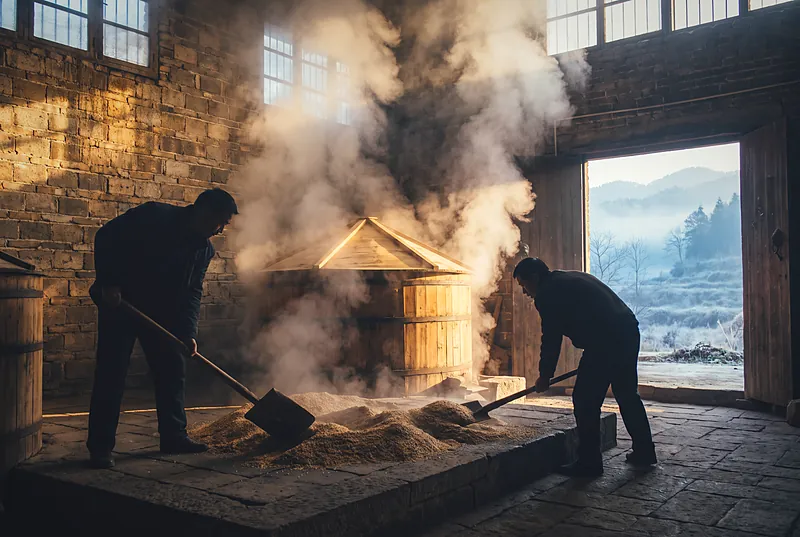
Among many brewers there is a simple piece of experience handed down: autumn and winter are the good months for making wine. When the air turns cold, the steam in a distillery stands out sharply against the morning, and the people making the spirit feel steadier too. Behind the saying lie both ancient records and the plain logic of fermentation.
Winter brewing, two thousand years ago
The "Monthly Ordinances" chapter of the Book of Rites describes what should happen in the second month of winter. The ruler orders the chief brewer to oversee the work in person, insisting that:
The grain be complete, the ferment timely, the soaking and steaming clean, the spring water sweet, the pottery good, the fire just right.
— Book of Rites, "Monthly Ordinances" 1
Later generations called these the "six musts". That such a list was set in deep winter shows that people long ago understood what cold weather does for brewing. Even today, yellow rice wine in the Yangtze delta is traditionally a winter brew, and makers of sauce-aroma baijiu speak of starting their grain around the Double Ninth, as autumn cools.
Temperature sets the rhythm
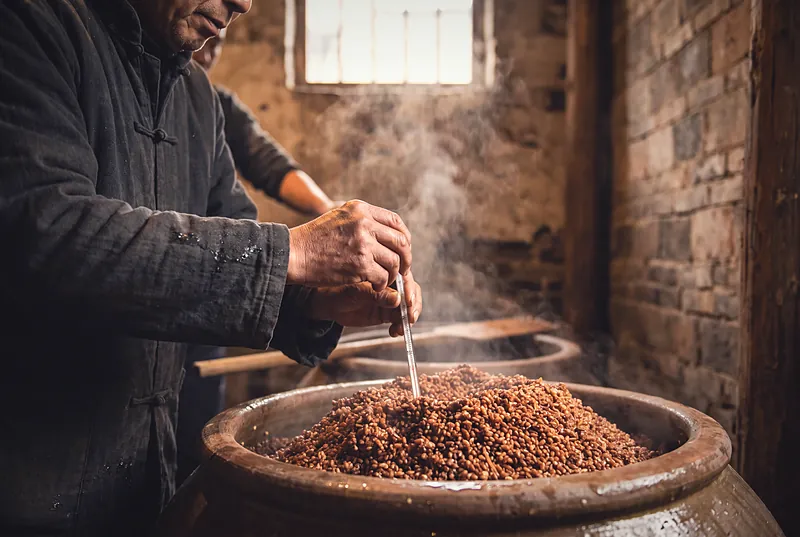
Strong-aroma baijiu is made by solid-state fermentation. Grain is steamed, spread to cool, mixed with daqu starter and packed into a mud pit, which is then sealed so that the microbes inside can work slowly. Brewers describe the ideal temperature curve in the pit as "slow at the start, steady in the middle, gently falling at the end" 2. A slower, more even fermentation gives aroma compounds time to form and makes for a rounder spirit.
In the cool months the temperature of the grain going into the pit is easy to control, the rise is gentle, and unwanted microbes have less chance to take hold. In high summer the fermenting grain heats too quickly, acidity tends to climb, and both yield and flavour are harder to manage. That is why many strong-aroma distilleries treat midsummer as a quieter season. "Autumn and winter are good for brewing" really means letting fermentation keep time with nature.
Four seasons at Qifu
Mianzhu lies at the foot of the Longmen Mountains, with glacier-fed springs, more than 1,200 mm of rain a year and a slightly acidic, sticky yellow clay. Those are the basic conditions for brewing here. Qifu follows the traditional method: pure grain and solid-state fermentation in yellow-mud pits sealed under a cap of red grain, about two months to a batch. The fermented grain is then distilled in a traditional zeng still, with the spirit graded and cut by quality as it flows, before it is laid down in clay jars. Grain that goes into the pits in early winter ferments slowly in the cold air and comes out two months later for distilling, which is when the distillery is at its steamiest.
The distillery works through all four seasons. What changes is where the brewers have to put their effort. One line of the Qifu family motto speaks of "striving without pause, learning from the old methods", and following the seasons without hurrying is part of those old methods. From the everyday Jin Qifu range to the flagship Bainian Qifu · 8, each drop carries something of the season in which it was made.
As the evenings grow cold, it's worth gathering a few friends, pouring small and sipping slowly. Drink responsibly, and talk about the seasons in the glass.