

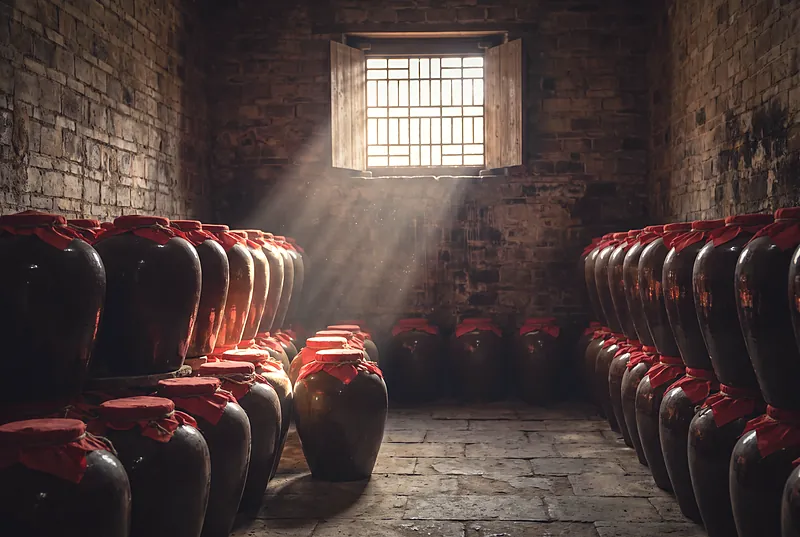
Walk into the store-room of an old distillery and the first thing you notice is usually the quiet. Rows of earthenware jars stand in order, their mouths sealed tight under red cloth or clay, and inside them time is passing out of sight. Why does baijiu like to live in clay? The answer starts with new spirit.
Why new spirit needs to rest
Spirit fresh from the still is called new spirit. Its aroma is forward, but on the palate it is often sharp and prickly, with what brewers simply call a "new-spirit" edge. After a period of storage it grows softer and more harmonious, and its aromas knit together. This process is known as ageing or maturation 2.
Ageing is more than leaving a jar alone. Over the years the alcohols, acids and esters in the spirit slowly change, some of the more pungent volatile compounds drift away, and the mouthfeel rounds out. Brewers generally agree that the vessel matters a great deal here, and the clay jar is Chinese baijiu's most traditional home.
A vessel that breathes
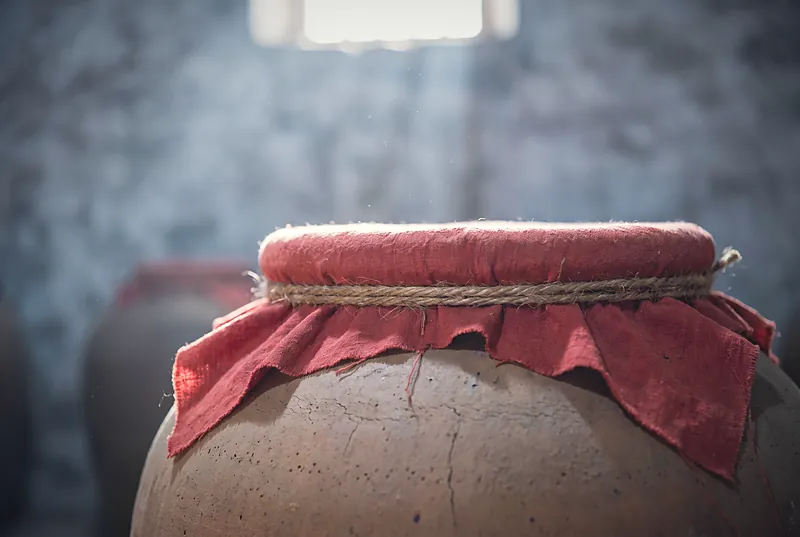
Clay jars are fired from earth, and their walls are full of pores too fine to see. People say the jars "breathe": they allow a very slow exchange of air between inside and out, so that oxidation and esterification can work quietly and the spirit gradually loses its fire. Stainless steel tanks are well suited to storing and moving large volumes, but the virtue of clay is precisely that it is slow.
People in ancient China were already particular about pottery. The Book of Rites, setting out the rules for winter brewing, says simply that "the pottery must be good" 1. A good vessel makes for a good wine. More than two thousand years later the rule still holds. Clay jars also have personalities: size, clay body and firing temperature vary, so the same spirit stored in different jars will taste slightly different after a few years. That is why a blender has to taste jar by jar.
Years in the jar at Qifu
At the foot of the Longmen Mountains in Mianzhu, Qifu's spirit ferments for about two months in yellow-mud pits. After distilling and grading it goes into clay jars to rest. The oldest reserves in the store-room are as old as the family distillery itself. The family has run it since 1978, so a generation of time is sealed up there, jar by jar.
The master blender's skill lies in reading these jars. Which jar has reached its full aged fragrance, which needs to wait, and which ones will flatter each other when combined: all of this has to be confirmed on the palate, again and again. Qifu Laojiao 20 is the more composed voice of our old-pit series, a way of handing the time gathered in the jars to the person holding the glass.
A spirit like this should not be rushed. Pour a small measure, take in the aroma first, then sip and let the layers time has left come through. Pour small, sip slowly and drink responsibly, so the quiet years in the jar get their due.