
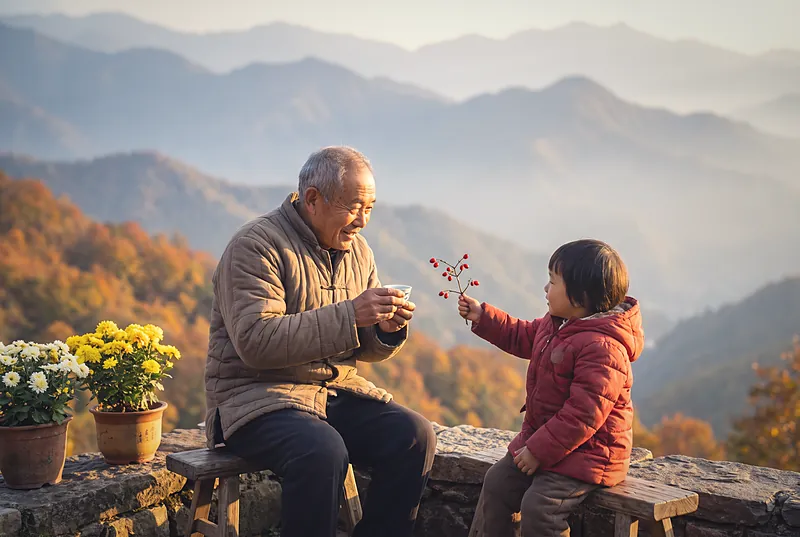
The ninth day of the ninth lunar month doubles the number nine, which ancient Chinese thought regarded as the fullest of the yang numbers. Hence its names: Chongjiu, "double nine", and Chongyang, "double yang". It falls in clear autumn weather, and for more than two thousand years people have marked it by climbing high, admiring chrysanthemums, wearing sprigs of dogwood and drinking chrysanthemum wine. In 2006 the festival was placed on China's first national list of intangible cultural heritage 1.
A year-long wine and a wish for "a long time"
The link between the Double Ninth and wine goes back to the Han dynasty. The Miscellaneous Records of the Western Capital describes palace women who, on the ninth day of the ninth month, wore dogwood, ate millet cakes and drank chrysanthemum wine. It adds that the wine was brewed from the flowers, stems and leaves with millet when the chrysanthemums bloomed, and was not ready until the same day the following year 2. Waiting a full year for one jar of wine says a great deal about what people were hoping for: things that last.
By the Tang dynasty the festival had entered poetry. At seventeen, living far from home in Chang'an, Wang Wei pictured his brothers on the hills without him:
I know my brothers, climbing high, wear dogwood – one short of all.
— Wang Wei, "Thinking of My Brothers on the Ninth"
Climbing high and looking far, people's thoughts turn to family. Meng Haoran ends a poem by promising an old friend he will return "on the Double Ninth, to enjoy the chrysanthemums."
From a climbing festival to a day for elders
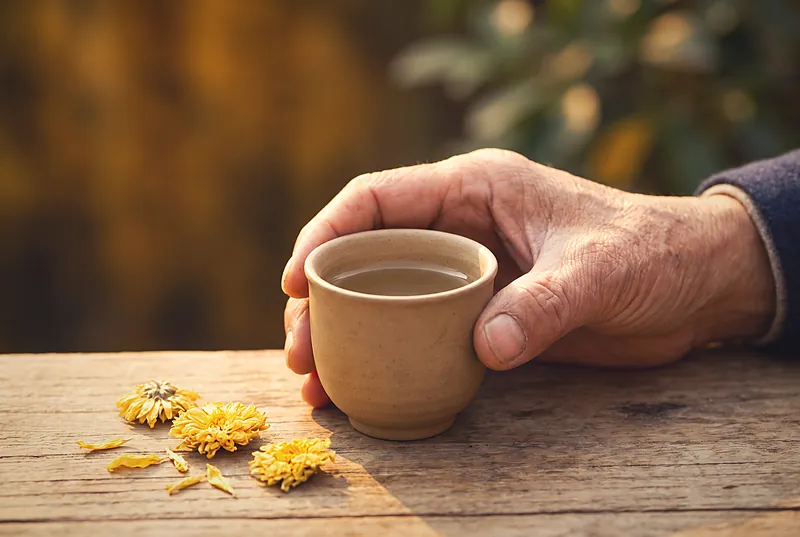
In Chinese, "nine-nine" (jiujiu) sounds like "for a long, long time", so the day gradually took on the meaning of wishing elders long life. In 1989 the ninth day of the ninth month was designated Seniors' Day 1, and China's Law on the Protection of the Rights and Interests of the Elderly, as revised in 2012, now states that the day is the Seniors' Festival 3. An ancient festival of hills and chrysanthemums has, quite naturally, become a festival of respect.
Few city families actually climb a mountain today. But a slow autumn walk with parents, a family dinner, and a small cup poured for the eldest at the table carry the same meaning. Custom says you hold the cup with both hands and keep its rim a little lower than the elder's when you toast. How much anyone drinks has never been the point.
An old wine for a day about time
In Mianzhu, autumn comes in clear and bright beneath the Longmen Mountains, and a cup for the Double Ninth ought to be a wine that has kept its own appointment with time. Qifu Laojiao 15, from our old-pit series of strong-aroma baijiu, is clear and mellow on the palate, firm yet gentle, with a quiet aged fragrance and a soft, rounded sweetness. In a way it resembles the elders it is poured for: gentle, with weight underneath. A small cup and a wish for jiujiu ankang, "well and at peace for many years", can mean more than a wrapped present.
One line of the Qifu family motto reads "character above the wine". Wine is for honouring people, and on this day the honour goes to the people who looked after us. Pour small, sip slowly and drink responsibly, so the Double Ninth leaves warmth behind and nothing heavier.