
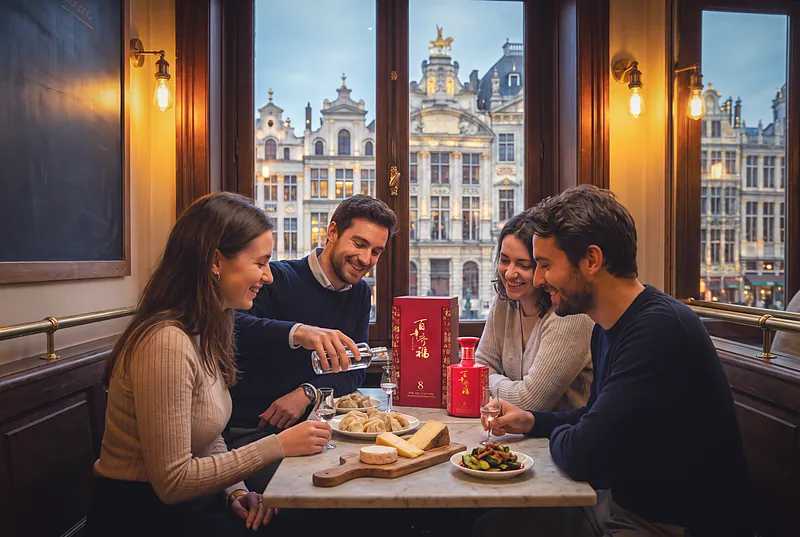
In Brussels, Stockholm or any European city, bring out a bottle of baijiu and your friends' first reaction is usually curiosity mixed with a little caution. Baijiu is often described as the world's most consumed spirit category by volume, yet in Europe it is still a taste many people have never tried 2. How do you introduce it so that the first sip leaves a good impression?
Start with the name
Baijiu means literally "white spirit", in the sense of clear and colourless. You might explain that it is a grain spirit, a cousin of whisky and vodka, but made very differently: the grain is saccharified and fermented with a starter called qu, the fermentation happens in a solid state rather than as a liquid, and the spirit is distilled in a traditional zeng still.
Then mention aroma styles. Baijiu has several main styles, and Sichuan is known for strong aroma (nongxiang). Strong-aroma baijiu is rich in an ester called ethyl hexanoate, which many people associate with ripe pineapple, pear and other fruit, layered with the earthy "pit aroma" that comes from the fermentation pits. Tell your friends to look for those notes and they will smell more attentively.
Small glasses, good food, a little etiquette
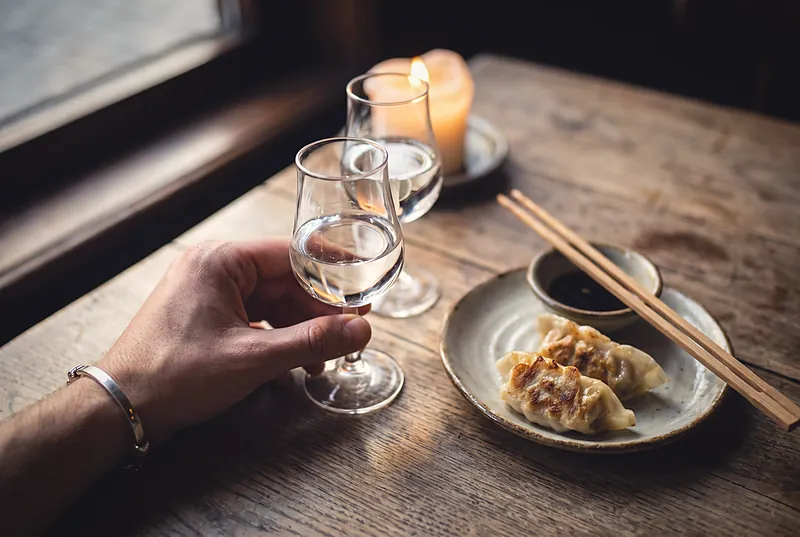
A spirit at 52% vol is not for gulping. Use small cups or tulip-shaped tasting glasses, pour just a little for each person, and serve at room temperature. Ask your friends to hold the glass under their nose and breathe slowly. The first sip should be tiny, held on the tongue for a moment before swallowing; the second sip usually shows more sweetness and fragrance than the first.
At a Chinese table, ganbei, "dry the cup", is common. At a first tasting, it is worth saying that ganbei is a courtesy, not an obligation. Drinking at your own pace, in small sips, is the best way to get to know a spirit.
Baijiu is rarely drunk on its own; it belongs at the dinner table. Sichuan food is the natural partner, but if that's not at hand, dumplings, grilled meats, a spiced stew or a strongly flavoured aged cheese are worth trying.
You can also share a bit of toasting etiquette: when you toast an elder or your host, hold the rim of your cup slightly below theirs as a sign of respect. Little details like this are often what friends find most interesting and remember longest.
Which bottle to begin with
Qifu is a family distillery at the foot of the Longmen Mountains in Mianzhu, Sichuan, exporting to Europe, Africa and Asia, with an EU contact in Belgium. Its export bottling, Shun Tun, is a strong-aroma baijiu at 52% vol in a 500 ml bottle, listed at Systembolaget in Sweden 1, and a good choice for a first tasting.
For a gift, or to show a fuller expression of the style, there is Bainian Qifu · 8: red bottle, red gift box, gold calligraphy, made from five grains, with a smooth entry, lingering sweetness and a nutty, caramel-like finish.
Introducing baijiu is really introducing a way of being together: sitting around a table, sharing, drinking slowly. What friends remember may not be the strength of the spirit, but the conversation and laughter of that evening.