Anyone buying baijiu will see words like "strong aroma", "sauce aroma" or "light aroma" on the label. Aroma style has become the most common way to classify Chinese baijiu. Yet few people realise that this vocabulary is not ancient at all. It was formally established only a little over forty years ago.
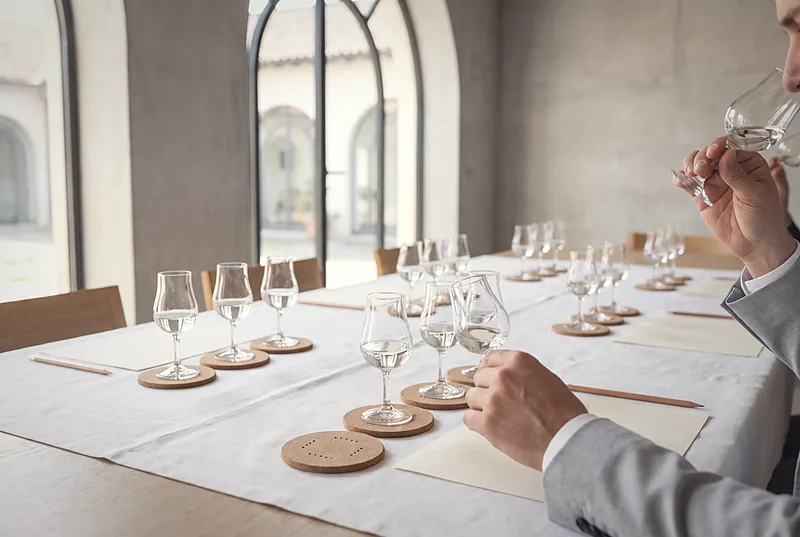
Sorting the glasses in 1979
After 1949, China held a series of national liquor competitions. In the early rounds, spirits of very different regional styles were judged side by side, which made fair comparison hard: a judge used to one kind of aroma struggled to assess a completely different one.
In August 1979 the Third National Liquor Competition was held in Dalian. For the first time, baijiu was grouped for judging by aroma style, production process and fermentation starter. Four basic aroma styles were defined (sauce, strong, light and rice), with everything else grouped as "other aromas" 1. From then on, Chinese baijiu had a widely shared common language. Among the eight national famous spirits named that year was Jiannanchun from Mianzhu 1, a point of pride for the whole Mianzhu region.
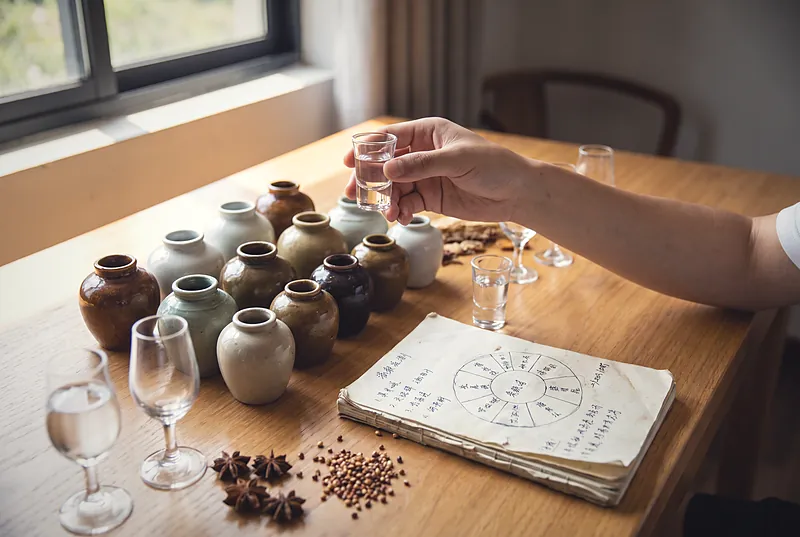
From four styles to more than ten
Each of the four basic styles had a classic example. Sauce aroma was typified by Kweichow Moutai, light aroma by Shanxi's Fenjiu, rice aroma by Guilin Sanhua, and strong aroma by the spirits of the Luzhou area in Sichuan, which is why strong aroma is also called "Lu-style".
Over the following decades, as distilleries explored and research deepened, further styles were recognised, among them feng, mixed, sesame, chi, te, herbal, Laobaigan and fuyu aromas. Today people usually speak of more than ten aroma styles, each with its own national or industry standard 2. None of them ranks above the others. The styles work more like a map that helps drinkers find the direction they enjoy.
Strong aroma: a fragrance grown in the pit
Of all the styles, strong aroma is the most widely made and drunk. It is characterised by a rich pit aroma, a smooth sweetness, balanced flavours and a clean, long finish. Its signature compound is ethyl caproate, and that fragrance is literally cultivated in mud pits used year after year. Sichuan is a major home of strong-aroma baijiu, with Yibin, Luzhou and Mianzhu all known for the style.
Strong-aroma baijiu is what Qifu makes. At the foot of the Longmen Mountains in Mianzhu, Qifu uses pure grain and solid-state fermentation in yellow-mud pits under a red-grain cap, about sixty days a batch. In 2016 Qifu became a strong-aroma demonstration base, and in 2018 it joined the China Baijiu Golden Triangle. The flagship Bainian Qifu · 8, distilled from five grains, has a smooth entry, lingering sweetness, a full pit aroma and a nutty, caramel-like finish, all classic marks of the strong-aroma style.
Next time you pour a glass, check the aroma style on the label, then smell what is in the cup and compare. Pour small, sip slowly and drink responsibly. Much of the pleasure of tasting lies in noticing these small differences.