Heavenly horses and grapes
The lunar Year of the Horse, a bingwu year in the traditional cycle, begins on 17 February 2026. For Chinese people the horse stands for energy and forward motion, and deep in history horses and wine often appear together.
Under Emperor Wu of Han, the envoy Zhang Qian travelled to the Western Regions and brought back news of distant lands. Sima Qian's Records of the Grand Historian notes that the people around Dayuan, in the Ferghana Valley, made wine from grapes, and that "the people love wine, and the horses love alfalfa"1. In a single line, people and horses each have their favourite, and both fascinated the Han court. Han envoys later brought back grape and alfalfa seeds to plant in fertile land, and the fine horses the emperor sought from the west were called "heavenly horses".
In 1969 a bronze galloping horse was excavated from the Leitai Han tomb in Wuwei, Gansu. Three hooves fly free while the fourth rests lightly on a bird in flight. Known as the "Horse Treading on a Flying Swallow", it was adopted as China's tourism emblem in 19832. Craftsmen nearly two thousand years ago cast speed and lightness into bronze.
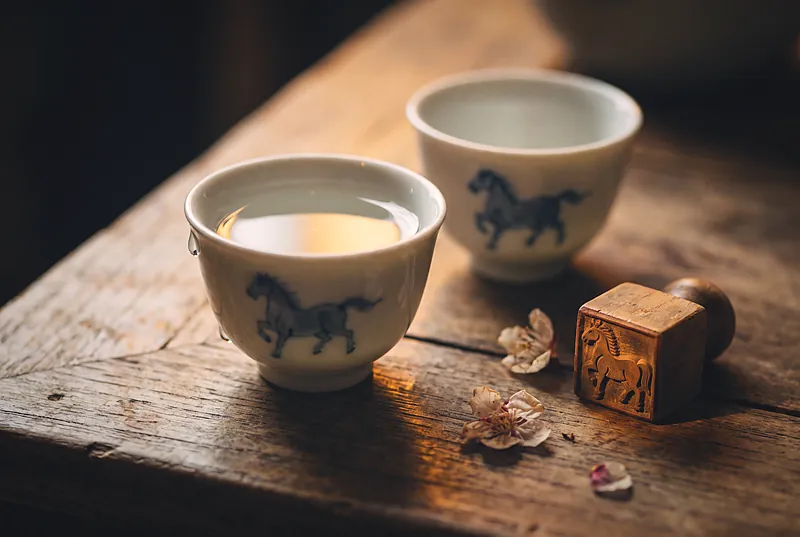
Horses in poems, wine in cups
By the Tang dynasty, horses and wine were constant companions in poetry. Wang Han's "Song of Liangzhou" describes soldiers at the frontier:
Fine grape wine in luminous cups; as we raise them, the pipa on horseback urges us on.
— Wang Han, "Song of Liangzhou"
The cup is barely full before the music calls the riders away, bold and melancholy at once. In "Bring in the Wine", Li Bai offers to trade his dappled horse and his costly fur coat for wine, all to drown "the sorrows of ten thousand ages" with his friends. Around Mianzhu a local legend tells of Li Bai taking off his sable coat to pay for the region's wine. Legend cannot be proved, but it shows how long this land has been linked with poetry and drink.
In everyday blessings, the horse is always a good omen: ma dao cheng gong, "success as soon as the horse arrives", and longma jingshen, "the vigour of the dragon-horse". Almost everyone uses these phrases when wishing a happy New Year.
The first cup of the Horse year
On New Year's Eve the family gathers, and the first cup at the reunion dinner usually goes to the elders, to honour the year's hard work and toast the year ahead.
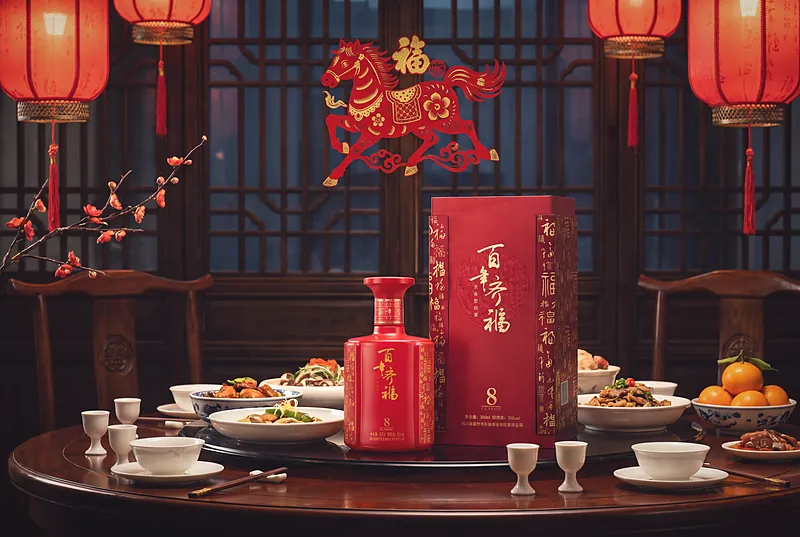
In Mianzhu, the Qifu family has tended its pits at the foot of the Longmen Mountains since 1978. At New Year many families put Bainian Qifu · 8 on the table: a red bottle in a red box with gold calligraphy, a strong-aroma baijiu at 52% vol made from five grains, smooth on entry with a lingering sweetness. Red is the colour of the season and suits the lively spirit of a Horse year, and the name Qifu, "blessings, all together", is exactly what one wants to say on New Year's Eve.
A horse goes far by keeping a steady pace, and a good spirit is best enjoyed with the same restraint. We wish you a Year of the Horse of small cups and slow sips. Please drink responsibly and never drink and drive.