
Li Shizhen's verdict
Where does a cup of baijiu come from? Put simply, fermented grain is heated, the alcohol rises as vapour, cools, and is collected. When Chinese people first did this, however, has been debated for a long time.
The most quoted answer comes from the Ming physician Li Shizhen in his Compendium of Materia Medica:
Shaojiu is not an ancient method; it was first created in the Yuan.
— Li Shizhen, Compendium of Materia Medica
He also described the method: strong wine and its lees are placed in a steamer, the vapour is driven upward, and the "dew" that drips down is caught in a vessel. The Yuan-era Essentials of Food and Drink by Hu Sihui mentions alaji liquor, generally taken to be a distilled spirit. For a long time, "distilled liquor began in the Yuan" was treated as settled.
Clues that keep moving earlier
The evidence, though, keeps pushing the date back.
The word shaojiu, "burnt wine", already appears in Tang poetry. Bai Juyi wrote of shaojiu "newly opened, with the fragrance of amber", and Yong Tao, arriving in Sichuan, wrote that once the shaojiu of Chengdu was ready he no longer wished to return to Chang'an. Scholars disagree about whether Tang shaojiu was distilled in the modern sense, but the lines show that the fine liquor of the Sichuan basin was already famous.
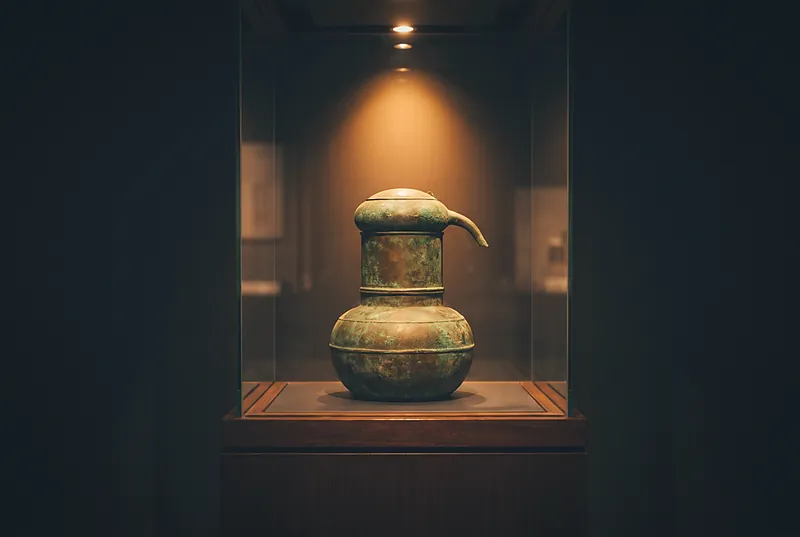
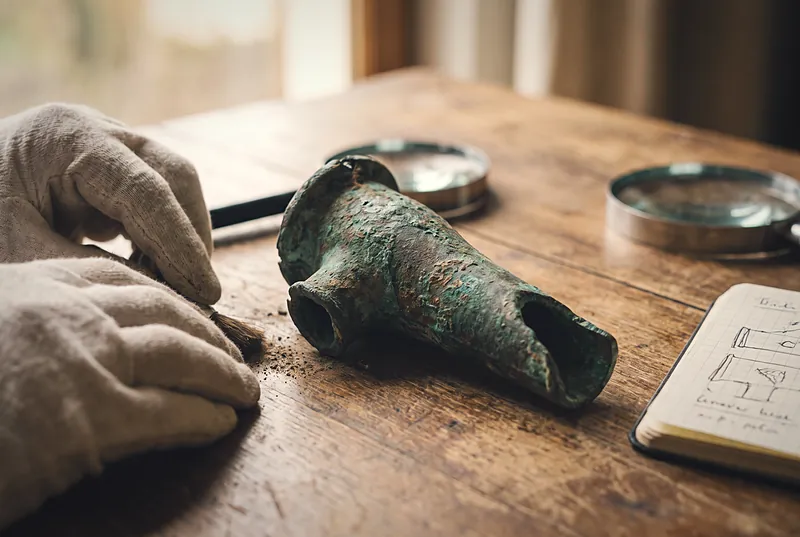
In 1975 a Jin-dynasty copper still was unearthed in Qinglong County, Hebei. Made of a lower boiling pot and an upper cooling vessel, it is regarded by many researchers as a key object in the history of Chinese distillation2. The Shanghai Museum also holds an Eastern Han bronze vessel that has been discussed as a possible still.
The latest development comes from the Western Han tomb of the Marquis of Haihun in Nanchang, Jiangxi. The tomb held a bronze distilling set made of a top pot, a cylindrical body and a cauldron. In 2024 archaeologists made a full-size replica and, using fermented grain, successfully distilled a liquor from it1. This moves the possible beginning of Chinese distillation much earlier. Of course, a vessel that can distil does not prove that people drank distilled spirits every day, and the debate will continue.
The old method in the steamer
Whichever dynasty it began in, Chinese baijiu is distilled in a distinctive way. Instead of boiling a liquid, the solid fermented grain is loaded into a wooden steamer called a zeng, and steam rises through the grain, carrying alcohol and aroma with it.
At the Qifu distillery in Mianzhu we still use the traditional zeng still. After about two months of fermentation in yellow-mud pits, the grain is scattered lightly into the steamer by the shovelful and distilled over a gentle fire. Our distillers then grade the spirit by quality as it flows, and each grade is laid down to age in clay jars. Centuries apart, the principle is the same one Li Shizhen described: drive the vapour up and catch the dew.
Our flagship, Bainian Qifu · 8, is made exactly this way, one still-load at a time: five grains fermented in the pit, distilled in the zeng, rested in clay jars and bottled at 52% vol, smooth on entry with a lingering sweetness. Next time you raise a cup, think of the centuries of distilling craft behind that clear sip.
The history may be rewritten again, but the patience a good batch requires has never changed. When you taste this old craft, please do so in small cups, and in moderation.