
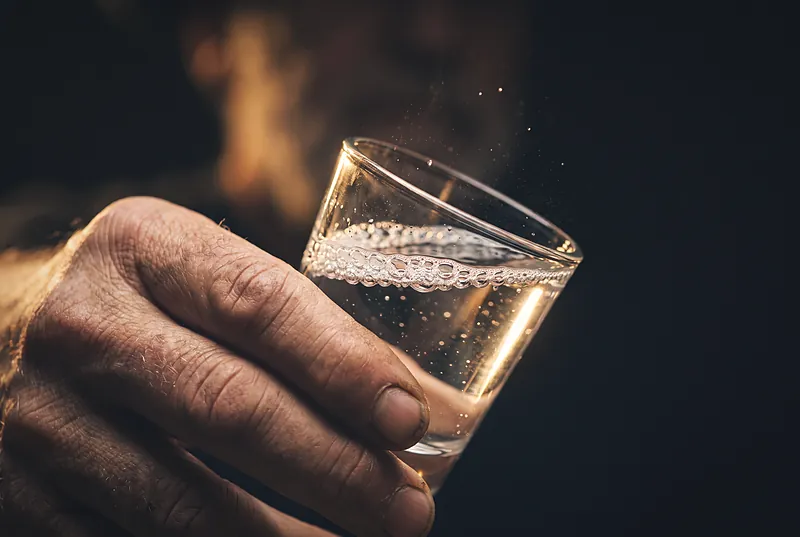
Before hydrometers, how did a distiller know how strong the freshly distilled spirit was? The answer lay in tiny, fleeting bubbles. In the baijiu trade these are called jiuhua, "wine flowers", what Western distillers call the bead, and the skill of judging strength by the bead and deciding what to keep is called kanhua zhaijiu, "reading the flowers, picking the spirit" 1.
What the bead is
When spirit is poured, shaken or splashed, a layer of small bubbles forms on its surface. Because alcohol and water have different surface tensions, spirits of different strengths form bubbles of different size, shape and lifespan. Broadly, the higher the alcohol, the larger the bubbles and the faster they vanish; the lower the alcohol, the finer and denser the bubbles and the longer they linger 12.
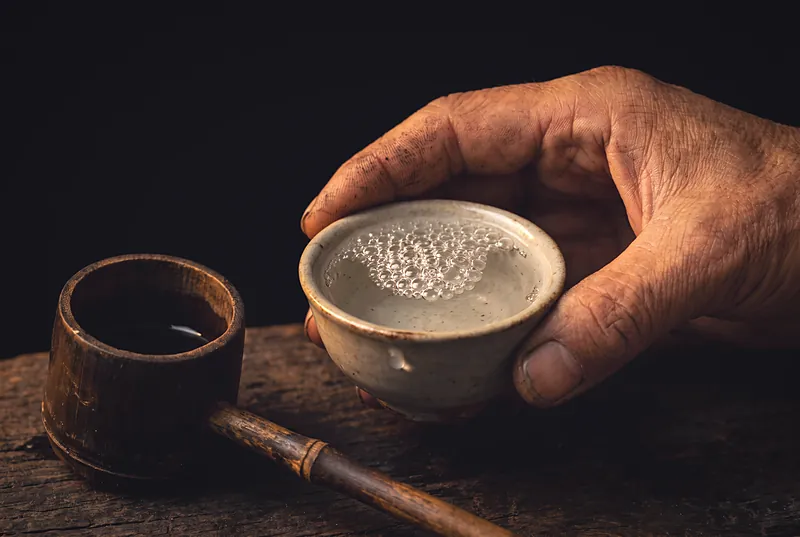
Old distillers gave the different beads vivid names. "Big clear flowers" are bubbles the size of soybeans, clear and gone in a moment. "Small clear flowers" are a little smaller and slower to disappear. "Cloud flowers" are fine and layered like a thin cloud. Then come "second flowers", and finally "oil flowers", specks floating on the surface like drops of oil, by which point the strength is very low. The names vary a little from region to region, but the principle is the same.
Choices at the still
The solid fermented grain is loaded into the zeng still, and steam rising from below carries the spirit out. The first runnings, the "heads", are high in alcohol and harsh in flavour. The middle section is the most balanced and forms the body of the spirit. Towards the end the strength falls and the "tails" grow thin and off-flavoured. "Pinching off the head and removing the tail" means separating these at just the right moment.
The distiller stands by the still, catches a little in a cup, gives it a gentle shake, glances at the bead and takes a taste, and knows where to cut and which jar it belongs in. This is liangzhi zhaijiu, selecting by quality: judging not only strength but also flavour, and grading the spirit into separate jars. Distilleries today have precise instruments, but many old masters still like to glance at the bead first. That glance is the product of decades spent standing beside the still.
Many people like to shake a bottle and watch how long the bead lasts. This does give a rough sense of strength, but it is worth saying clearly: the bead mainly reflects alcohol content and cannot on its own tell you whether a spirit is good. Real quality is judged by nose and palate, and proven by time.
Qifu Laojiao: the work of eye and hand
At the Qifu distillery at the foot of the Longmen Mountains in Mianzhu, distillation still uses a traditional zeng still, the spirit is selected and graded by quality, and new spirit rests in clay jars. Qifu Laojiao 15 Year and 20 Year are the sum of this work. The 15 Year is described as clear and sweet, firm yet gentle, with an elegant aged fragrance and a soft, rich depth. That balance of firmness and gentleness comes both from the old pits and from every well-judged cut at the still.
Pour a small cup of Qifu Laojiao, swirl it gently, watch the fine bead in the cup, then smell slowly and sip slowly. What you are looking at is not just bubbles, but an old distiller's trained eye.