Many celebrated works in the history of Chinese calligraphy are bound up with wine. Ink is calm and wine is unrestrained, yet in the hands of certain masters the two met and left behind some of the most admired pages ever written.
A cup and a poem at the Orchid Pavilion
In late spring of the ninth year of Yonghe, 353 AD, Wang Xizhi gathered with more than forty literati, including Xie An and Sun Chuo, at the Orchid Pavilion in Shanyin, Kuaiji, for the spring purification rite. They sat along both banks of a winding stream while cups of wine floated down the current; whoever a cup stopped before had to drink and compose a poem. Wang wrote the preface to the poems of that day:
One cup, one song: enough to pour out our deepest feelings.
— Wang Xizhi, Preface to the Orchid Pavilion Poems
Legend says he wrote it in a single flowing session after drinking, and could never match it when he tried again. The original has long been lost, yet the Lanting Preface is still revered as the finest work of running script under heaven 4.
Crazy Zhang and Drunken Su
In the Tang the bond between wine and the brush grew even more legendary. Zhang Xu was famous for wild cursive. The New Book of Tang records that he loved wine and, whenever thoroughly drunk, would shout and run about before taking up the brush, sometimes even dipping his hair in the ink to write. Sober again, he would look at the result, think it divinely inspired and find he could never repeat it. People called him "Crazy Zhang" 1. Du Fu gave him a line in "Song of the Eight Immortals of the Wine Cup":
Three cups, and Zhang Xu's fame as Sage of Cursive spreads; cap off, head bare, before princes and dukes.
— Du Fu
A little later, the monk Huaisu, also fond of wine and a master of wild cursive, was paired with him in the phrase "Crazy Zhang and Drunken Su" 2. Huaisu's Autobiography scroll, its strokes racing like sudden rain and whirlwind, is now held in the National Palace Museum in Taipei.
Behind the drunken cursive, however, lay decades of sober practice. Zhang Xu also excelled in rigorous, exact standard script 3, and legend says Huaisu wore out so many brushes that he buried them in a "brush tomb". Wine may loosen inhibition and lend the brush a touch of innocence, but it cannot replace skill. It only opens a door; the road beyond is made stroke by stroke, day after day.
A bottle in the study
Few people today actually write while drunk, but a good bottle and a small cup in the study remain a habit of many who love the brush. Finishing a piece of calligraphy, pouring a small glass and watching the ink slowly dry is an unhurried way to end the day.
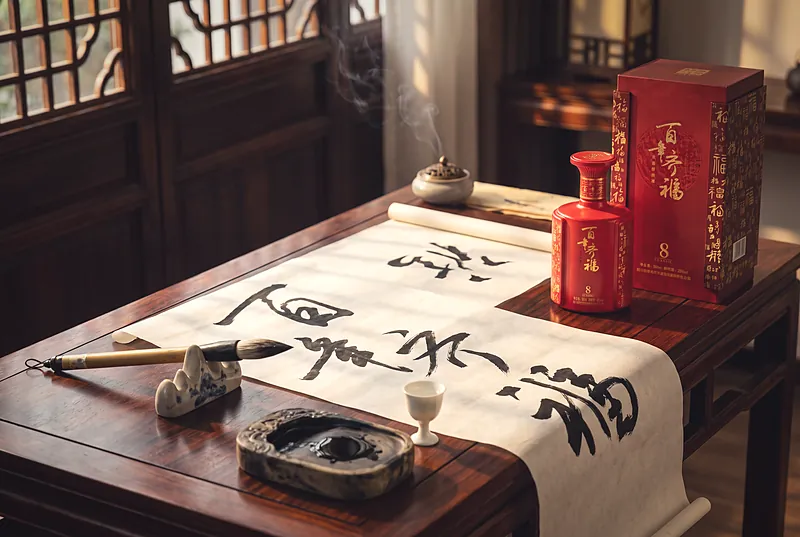
The red gift box of Bainian Qifu · 8 carries gold calligraphy of its own, at home among brushes and inkstones. Made from five grains, at 52% vol, it enters smoothly, with a full pit aroma and a nutty, caramel-like finish, a spirit for sipping slowly under the lamp. Given to a friend who loves calligraphy, it is a gift that shows understanding.
When the ancients spoke of "drunken ink", they meant ease and sincerity of spirit. Today we can take the spirit without the excess: a small glass, a modest sip, and a clear head kept for tomorrow's brushwork.